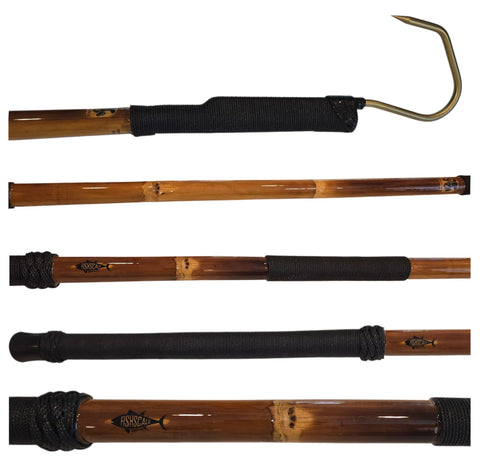
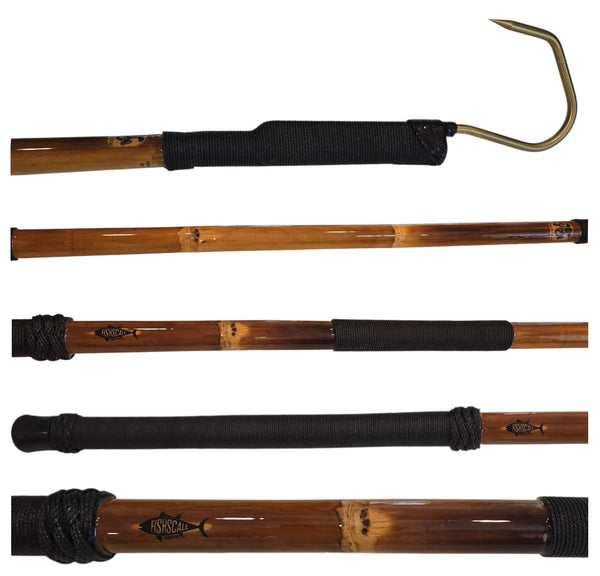
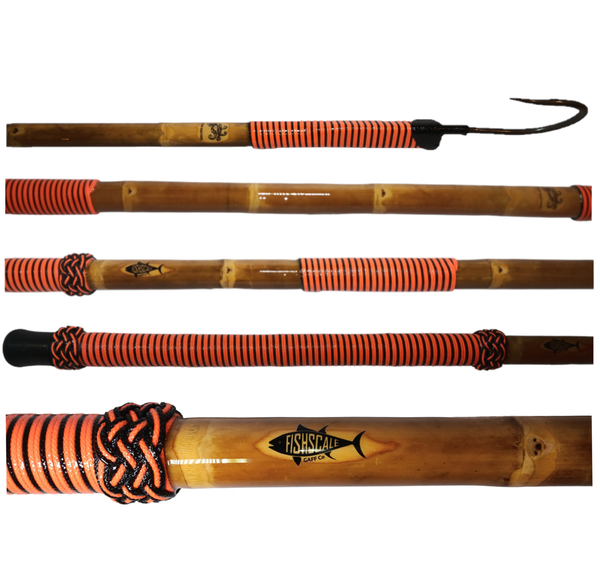
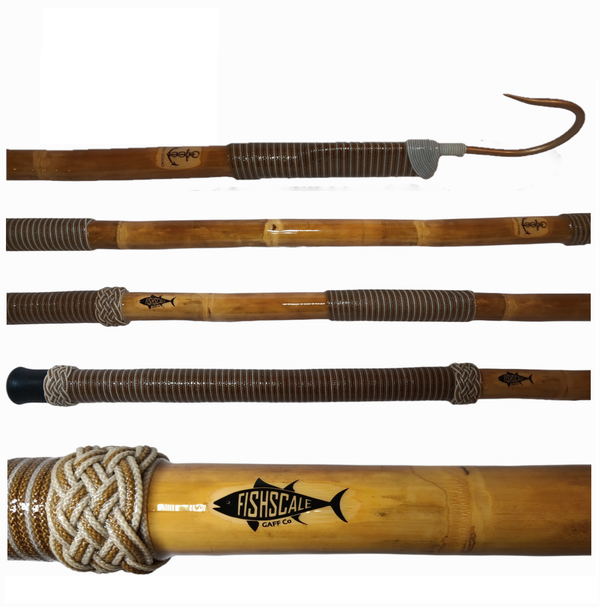
Ask ten offshore captains about gaffs and you'll hear the words flying gaff and straight gaff a lot. They do the same basic job, getting a fish from the water onto the boat, but they work in completely different ways and they're built for very different fish.
Here's how each one works, when to use which, and which one most anglers actually need.
Quick answer
- Straight gaff (also called a fixed-head gaff): the hook is fixed to the end of the pole. You stick the fish and lift it aboard with the pole. Best for almost every fish most anglers catch: yellowtail, dorado, wahoo, white seabass and tuna up to roughly 100 lb.
- Flying gaff: the hook detaches from the pole once it's set, and the fish is held by a heavy rope tied off to a cleat. Built for giant fish, like big bluefin, swordfish and marlin, that are too heavy or too strong to lift with a pole.
What is a straight gaff?
A straight gaff is what most people picture: a pole with a hook permanently attached to the end. You reach out, set the hook in the fish's head or shoulder, and use the pole to lift or slide the fish over the rail.
Pros:
- Fast, simple and easy for one person to use
- Gives you full control of the fish's head right up to the deck
- Nothing to rig, nothing to tangle
- Works from kayaks, skiffs, center consoles and sportfishers
Cons:
- The pole takes all the load, so there's a limit to how big a fish you can lift with it
- A really big fish that surges after the shot can twist the gaff out of your hands
Straight gaffs come in different lengths and hook gaps. Our gaff size guide breaks down which length and hook fits your boat and fish.
What is a flying gaff?
A flying gaff has a large, heavy hook that slips into a socket on the end of a pole. A thick rope is tied to the hook, and the other end is tied off to a cleat or bitt on the boat. When you set the hook, the pole pulls free and the fish is held by the rope instead.
Pros:
- Holds fish far too heavy to lift with a pole
- The boat takes the load, not the angler's arms
- Safer when a giant fish surges or rolls after the shot
Cons:
- Needs rigging, deck space and a strong cleat
- Usually takes two people (one to gaff, one to handle the rope)
- The rope under load is dangerous if it wraps a hand or leg
- Overkill for the vast majority of fish
Flying gaff vs. straight gaff: side by side
| Straight gaff | Flying gaff | |
|---|---|---|
| How it holds the fish | Hook fixed to the pole | Hook detaches; rope tied to the boat |
| Best for | Yellowtail, dorado, wahoo, white seabass, most tuna | Giant bluefin, swordfish, marlin, big sharks |
| Crew | One person | Usually two |
| Boat | Anything from a kayak up | Larger boats with strong cleats |
| Setup | None | Rope, cleat, hook and pole rigged before the bite |
| Learning curve | Low | High, and less forgiving |
Which one do you need?
For most anglers, the answer is a straight gaff. If you fish from a kayak, skiff, bay boat or center console and target yellowtail, dorado, wahoo, white seabass or school-to-mid-size tuna, a straight gaff handles everything you'll catch.
A flying gaff starts to make sense when you're regularly targeting fish well over 100 lb. Even then, most boats that carry one also keep one or two straight gaffs on board for the smaller fish and for a second shot on a big one.
Some quick rules of thumb:
- Kayak or small boat, fish under about 40 lb: 3–4 ft straight gaff, 2.50–2.75" hook gap
- Center console or sportfisher, fish up to about 100 lb: 5–6 ft straight gaff, 3.00–3.25" hook gap
- Big tuna: straight gaff with a 4.00" hook gap for the first shot, and a flying gaff on board if you're targeting true giants
Why bamboo makes a better straight gaff
Most straight gaffs today are aluminum or fiberglass. Calcutta bamboo has a few real advantages:
- It flexes. Bamboo bends a little with a fish's head shakes instead of transferring every jolt to the hook, so the gaff is less likely to tear out.
- It floats if it goes overboard.
- It won't gouge gelcoat the way bare aluminum can.
- It grips when wet, especially with a cord-wrapped handle.
We compare the materials in more detail in bamboo vs. fiberglass vs. carbon fiber gaffs.
After the gaff: finish the job right
Getting the fish aboard is only half of it. To keep the meat in top shape, kill it quickly with a tuna spike, then bleed it and get it into an ice slurry. See our guides on ike jime and how to bleed a fish.
FAQ
What is a flying gaff used for?
Landing very large fish, like giant bluefin, swordfish and marlin, that are too heavy to lift with a fixed gaff. The hook detaches from the pole and the fish is held by a rope tied to the boat.
Can one person use a flying gaff?
It's possible, but it's much safer with two: one to set the hook and one to manage the rope.
What size straight gaff do I need for tuna?
For most yellowfin and bluefin, a 5–6 ft gaff with a 3.00–3.25" hook gap. For big tuna, step up to a 4.00" hook gap.
Can I get a straight gaff in my boat's colors?
Yes. Pick a signature colorway from our Calcutta bamboo gaffs, or design your own with the Custom Gaff Builder.