Search for an "ike jime tool" and you'll find everything from $8 eBay spikes to $150 kits full of wires, knives and pouches. Some of it is great. A lot of it is the wrong tool for the fish you actually catch.
Here's what you really need to do ike jime properly, what each tool does, what to look for, and whether a kit is worth it.
Quick answer: the ike jime tools you need
- A brain spike to kill the fish instantly. This is the one tool you can't skip.
- A sharp knife to cut the gills or behind the pectoral fin so the fish bleeds out.
- Shinkei jime wires (optional) to destroy the spinal cord and slow rigor mortis.
- A bucket or kill bag of seawater to bleed the fish in.
- An ice slurry: crushed ice plus seawater, ready before the first bite.
New to the method? Start with our step-by-step ike jime guide, then come back here to set up your kit.
1. The brain spike (the most important tool)
The spike does the actual ike jime: it goes into the brain and kills the fish in about a second. If it's too thin, too short or too flimsy, it bends or skates off a hard skull, and a missed spike is the one way ike jime goes wrong. Spend your money here first.
Types of ike jime spikes
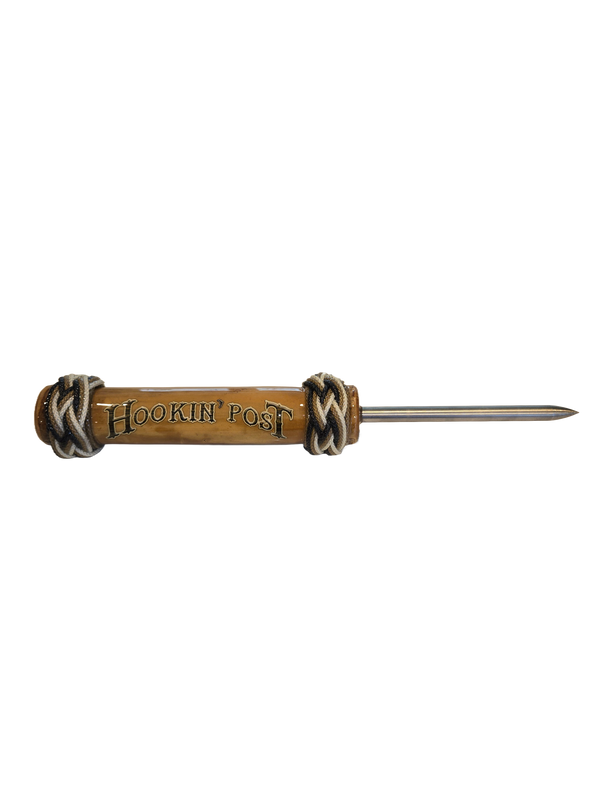
- Straight handled spike: a solid stainless spike set in a handle you can grip like a screwdriver. Simple, strong and the easiest to aim. This is what we make.
- T-handle spike: a spike with a crossbar handle you push with your palm. Lots of force, a little bulkier to store.
- Hollow spike: a tube-shaped spike. After the brain is spiked, a wire is fed through it for shinkei jime. Handy, but the hollow tube is usually thinner and less stiff than a solid spike.
- Knife or multi-tool spikes: a short spike built into a knife handle or multi-tool. Better than nothing for small fish, but usually too short for tuna.
What to look for in a spike
- Stiff, solid stainless steel. 316 stainless resists rust and won't flex on a thick skull.
- The right size for your fish. See the table below.
- A grip that works wet. Blood and slime make smooth handles slippery. Cord wraps, texture or a shaped handle help.
- A way to cover the point. A sheath keeps the tip sharp and keeps it out of your leg in a tackle bag.
Spike size by fish
| Spike | Best for |
|---|---|
| 1/4" diameter × 4" | Yellowtail, bonito, dorado, rockfish, snapper and school-size tuna |
| 5/16" diameter × 4.5" | The all-around size for yellowfin and bluefin. The safe pick if you're unsure. |
| 3/8" diameter × 5" | Big tuna and other large, thick-skulled fish |
Our Calcutta bamboo tuna spikes come in all three sizes ($94.99–$164.99), with 316 stainless spikes, cord-wrapped bamboo handles and an optional screw-on sheath. You can also design one in your boat's colors.
2. A sharp bleeding knife
Right after the spike, you cut so the still-beating heart pumps the blood out. You don't need anything fancy:
- A short, stiff blade (about 3–4") with a sharp point is easier to control than a long fillet knife.
- Stainless steel and a grippy handle, for the same reasons as the spike.
- Keep it in a sheath next to the spike so both are within one-hand reach.
Where to cut, and how long to bleed, is covered in how to bleed a fish.
3. Shinkei jime wires (optional)
Shinkei jime is the advanced step: a long, flexible wire run down the spinal cord to stop the nerves firing. It slows rigor mortis and helps fish hold their quality for days, which matters most if you eat fish raw or age it.
- Length: the wire should be about as long as the fish.
- Thickness: thin wires for small fish, thicker wires for tuna. Too thin and it kinks; too thick and it won't fit the spinal canal.
- Buy a set. Wires usually come in sets of several sizes, which covers most fish on a mixed-bag day.
We don't make wires. Pair any good wire set with a solid brain spike. The full technique is in our shinkei jime guide.
4. Somewhere to bleed it, and an ice slurry
- Bucket, kill bag or fish box filled with seawater, so the fish drains head-down without painting the deck.
- Ice slurry: crushed ice mixed with seawater until it's slushy. It chills the fish much faster than ice cubes alone, which is the best defense against tuna burn.
Should you buy an ike jime kit?
Ike jime kits bundle a spike with a set of wires, and sometimes a knife and a pouch. They're a convenient way to start. The catch is that the spike in many kits is short and thin. That's fine for mackerel, snapper or rockfish, but it can struggle with the skull of a yellowfin or bluefin.
| Ike jime kit | Build your own setup | |
|---|---|---|
| Convenience | Everything in one box | Pick each piece yourself |
| Spike | Often short and thin | Sized to your fish (1/4" to 3/8") |
| Wires | Usually included | Add a wire set if you want shinkei jime |
| Best for | Smaller fish, trying ike jime for the first time | Tuna, yellowtail and anyone who fishes often |
Our advice: if you fish for tuna or yellowtail, build your setup around a proper spike, then add a wire set and a good knife. If you mostly catch small fish, a kit is a fine place to start.
Recommended setups
- Weekend inshore angler (rockfish, calico bass, snapper): a 1/4" spike and a short knife.
- Offshore angler (yellowtail, dorado, yellowfin): a 5/16" spike, a stiff bleeding knife, a kill bag and a big cooler for slurry.
- Tuna specialist or sushi-grade fish: a 3/8" or 5/16" spike, a wire set for shinkei jime, a knife, and plenty of ice.
FAQ
What tool is used for ike jime?
A brain spike (also called an ike jime spike or tuna spike) to kill the fish, a knife to bleed it, and optionally a wire for shinkei jime.
What's in an ike jime kit?
Usually a spike and a set of shinkei jime wires, sometimes with a knife and a carry pouch.
Can I use a screwdriver or ice pick?
It's not a good idea. They bend or slip on thick skulls, and a missed spike hurts the fish without killing it. A stiff stainless spike sized to the fish is faster, safer and more humane. More on that in the most humane way to kill a fish.
What size ike jime spike do I need for tuna?
5/16" for most yellowfin and bluefin, 3/8" for big fish, and 1/4" for school-size tuna.