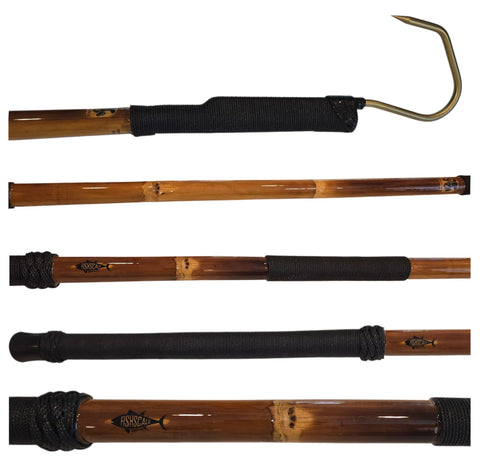
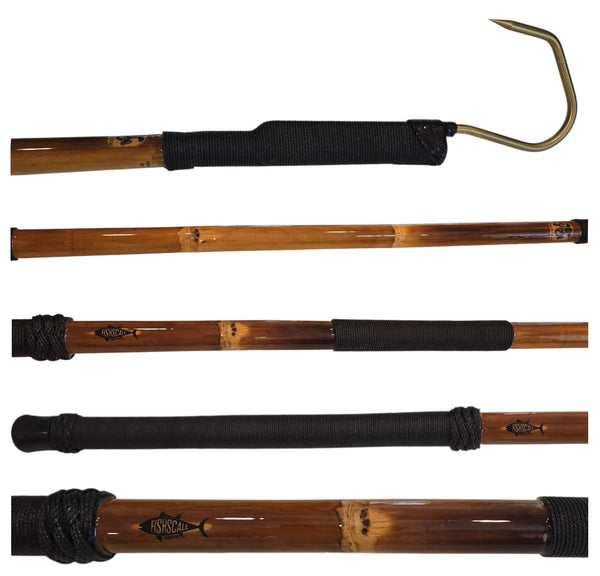
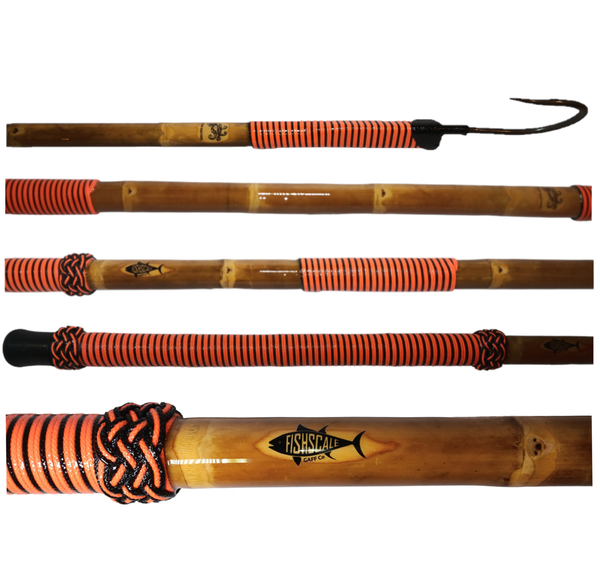
If you've shopped for a bamboo gaff, fishing pole or ski pole, you've seen the words Calcutta bamboo. If you've read about classic fly rods, you've seen Tonkin bamboo. They're both bamboo, but they're different plants with different strengths, and that's why one ends up in gaffs and the other in split-cane fly rods.
What is Calcutta bamboo?
Calcutta bamboo is the common name for Dendrocalamus strictus, a bamboo native to India and Southeast Asia. It got its name from the port of Calcutta (now Kolkata), where it was shipped around the world. It's also called male bamboo, solid bamboo or iron bamboo, because its canes have unusually thick walls and the lower sections can be nearly solid.
That thick wall is what makes it special. Calcutta cane is strong and tough for its size, but it still bends instead of snapping. Historically it was used for whole-cane fishing poles, ski poles, walking sticks and, of course, gaffs.
What is Tonkin bamboo?
Tonkin bamboo is Pseudosasa amabilis, which grows in a small region of southern China. It's sometimes called "tea stick" bamboo. Tonkin has long, straight sections between the nodes and very dense, strong fibers running down its length. Those qualities make it ideal for split-cane fly rods, where rod makers split the cane into strips and glue them back together into a tapered rod.
Early bamboo fly rods were often made of Calcutta cane. Tonkin largely replaced it for fine split-cane rods, but Calcutta remained the go-to for whole-cane tools that take a beating.
Calcutta vs. Tonkin bamboo
| Calcutta bamboo | Tonkin bamboo | |
|---|---|---|
| Species | Dendrocalamus strictus | Pseudosasa amabilis |
| Grows in | India and Southeast Asia | Southern China |
| Cane walls | Very thick, sometimes nearly solid | Thinner, with dense outer fibers |
| Nodes | Closer together, more pronounced | Farther apart, long straight sections |
| Character | Tough, with a forgiving flex | Stiffer and springier |
| Classic uses | Gaffs, whole-cane poles, ski poles, walking sticks | Split-cane fly rods |
Why Calcutta bamboo makes a great gaff
- It flexes under load. When a fish shakes its head after the shot, a bamboo shaft gives a little instead of passing every jolt straight to the hook. That helps keep the hook in.
- It's strong for its weight. The thick walls handle the lift and leverage of a big fish at the rail.
- It floats. Drop it overboard and you can go back for it.
- It won't gouge the boat. Bamboo is kinder to gelcoat than bare metal.
- It grips well, especially with a cord-wrapped handle.
- Every piece is unique. Natural nodes and grain mean no two gaffs look exactly alike.
Bamboo does need a little care: rinse it, dry it and keep the finish in good shape. Our guide on how to care for a bamboo gaff covers it. For how bamboo stacks up against fiberglass and carbon fiber, see bamboo vs. fiberglass vs. carbon fiber gaffs.
What we make from Calcutta bamboo
- Calcutta bamboo gaffs: 3–6 ft, with ceramic-coated Mustad, 316 stainless or titanium hooks
- Calcutta pick gaffs: 24" and 32"
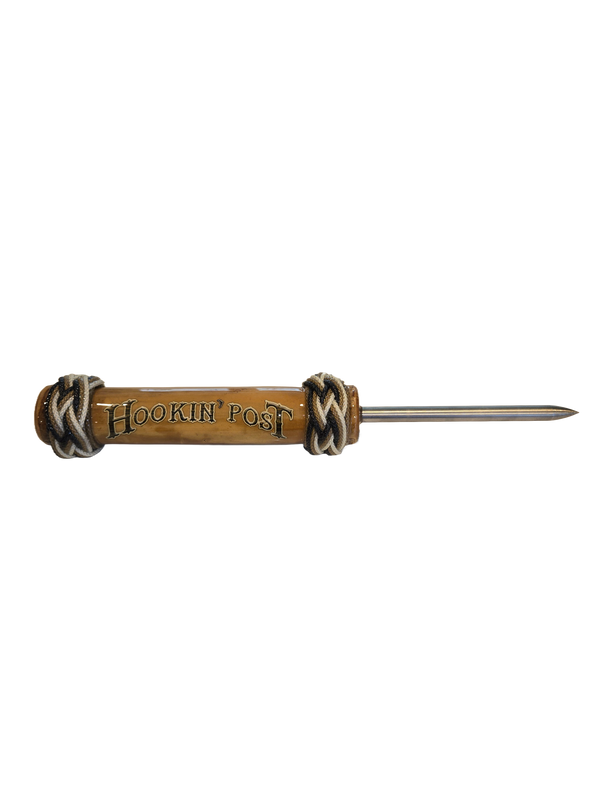
- Calcutta tuna spikes: 316 stainless ike jime spikes on bamboo handles
- Calcutta deck brushes: 3, 4 and 5 ft handles
- Custom builds of all of the above, in your colors
FAQ
Is Calcutta bamboo strong?
Yes. Its thick walls make it unusually strong and tough for bamboo, which is why it's used for gaffs and poles that take a beating.
Is Calcutta bamboo the same as Tonkin?
No. They're different species. Calcutta is thicker-walled and tougher; Tonkin is straighter and springier, which suits split-cane fly rods.
Does a bamboo gaff float?
Yes. A Calcutta bamboo gaff floats if it goes overboard.
How long does a bamboo gaff last?
With basic care (rinse, dry, keep the finish up) a well-made Calcutta gaff can last for many seasons.